- Ana
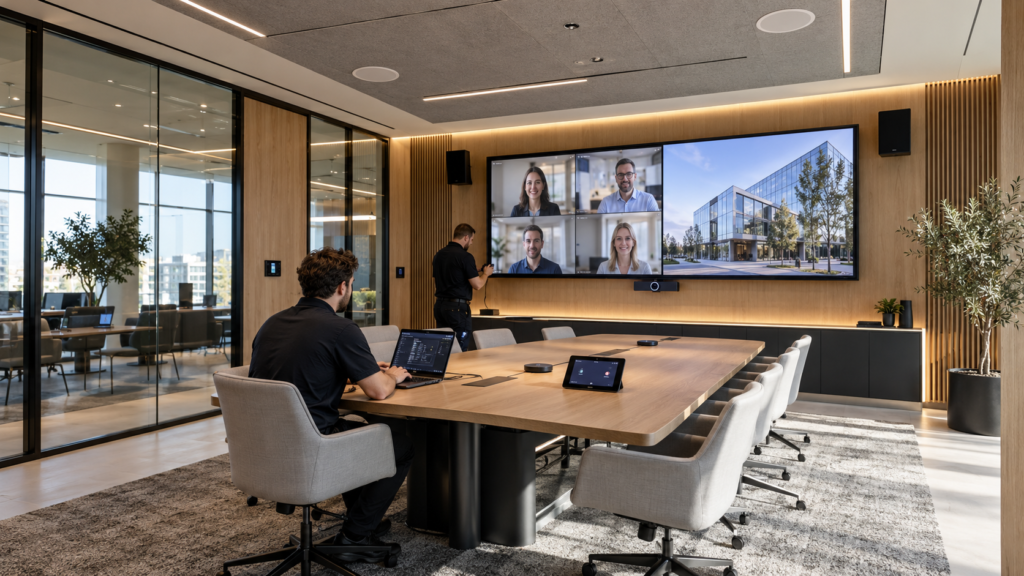
Your company moves into a new office in six months. The fit-out contractor wants cable routes, IT wants every device on a secure network, facilities wants rooms that “just work”, and three suppliers have each quoted their own part. Nobody has yet been asked to make it all work together on day one and keep it working afterwards. That missing role is what an AV/IT systems integrator fills.
This article explains what an integrator does at each stage of a project, how the role differs from a reseller or a consultant, and the signs that your project needs one.
Key takeaways
- An AV/IT systems integrator designs, installs, programmes, tests and supports audiovisual and IT systems as one working whole.
- Its main value is a single point of responsibility: one contract and one team accountable for the result.
- The need is growing as offices, universities, hospitals and public institutions modernise, often with EU funding.
- You need one when several systems, trades or sites must work together, or when downtime is costly.
- Choose a partner for its process, certified people and local support, not for hardware price alone.
What does an AV/IT systems integrator do?
An AV systems integrator turns business requirements into working technology: meeting rooms, auditoriums, control rooms, signage networks, sound systems and the IT infrastructure underneath them. The integrator does not just supply equipment. It takes responsibility for how the parts behave together, in your building, on your network, for your users.
In practice, the work follows six stages:
- Consult and assess. Workshops with users, IT and facilities to define use cases, a site survey, and a realistic budget. This is where most costly mistakes are prevented.
- Design and engineer. System schematics, rack and cable plans, acoustic and sightline checks, and a network design agreed with your IT team. Good designs follow industry standards and manufacturer guidelines, not habit.
- Procure and stage. Vendor-neutral selection of equipment that fits the design, followed by logistics and, where possible, pre-configuration before anything reaches site.
- Install and integrate. Cabling, mounting, control programming, and integration with networks, calendars, identity systems and building services, coordinated with the other trades on site.
- Verify and hand over. Every room and system is tested against the agreed design before handover, followed by user training and as-built documentation.
- Support and evolve. Service levels, a helpdesk, preventive maintenance, remote monitoring and a refresh plan, so the system keeps performing after the project team has left.
The role has also grown. New office buildings, university campuses, hospitals and public institutions, many of them modernising with EU funds, all need AV systems that run on the IT network, follow security rules and come with reliable local support. An integrator today must be as comfortable with networks and security policies as with loudspeakers and displays.
Integrator, reseller, consultant or in-house team?
Buyers often compare an integrator’s quote with a reseller’s price list, but the services are different. A reseller supplies products and stands behind them under warranty. A consultant designs and specifies, then oversees others. An in-house IT team can handle simple rooms but rarely has AV specialists or 24/7 cover. An integrator designs, delivers, verifies and supports the whole system, and answers for the outcome.
These roles can work together, for example a consultant writing the specification and an integrator delivering it. In a design-build model the same partner does both, which closes the gap between design intent and installation.
When do you need an AV systems integrator?
A single huddle room with an all-in-one video bar can be handled by a capable IT team. You will benefit from an integrator when:
- several technologies, such as video conferencing, signage, sound and room booking, must work as one;
- the project involves construction or fit-out, and cabling, power and acoustics must be planned before walls close;
- downtime is costly, as in control rooms, hospitals or council and plenary sessions;
- you buy through a public tender and need one contractor accountable for design, delivery and warranty;
- you are standardising many rooms or sites and your team has no AV specialists.
If two or more of these apply, bring an integrator in early, ideally before the architectural design is frozen.
How to choose the right integrator
The lowest hardware price rarely gives the lowest total cost. Before you sign, ask about:
- Process: defined stages, design reviews and sign-off points.
- People: certified engineers and programmers, with manufacturer certifications.
- Verification: a sample commissioning report and the standard it follows.
- Support: response times, support hours and coverage, in writing.
- References: comparable projects, and the financial stability to honour a multi-year contract.
How ELTEK Integrate helps
ELTEK Integrate has worked as an AV/IT systems integrator for more than 25 years, as part of AVITECH Group. We work design-build: the same team takes your project from consultancy and design through procurement, installation and commissioning to maintenance and managed services, under a single point of responsibility.
- Consultancy and design for corporate, government, education, healthcare, venue and mission-critical spaces.
- Integration and installation by certified engineers with national coverage in Romania and regional reach across CEE, backed by the AVITECH Group Logistics Center.
- A showroom where your stakeholders can test solutions before committing.
- 24/7 technical support through our Customer Service Division, plus maintenance and managed services.
Our references range from conference, interpretation and electronic voting systems at the Romanian Chamber of Deputies to unified communications and room booking at UiPath and Superbet, and the permanent sound system at Beraria H in Bucharest.
Frequently Asked Questions
What is the difference between an AV integrator and an AV installer?
An installer mounts and connects equipment to someone else’s design. An integrator also designs the system, programmes it, connects it to your IT environment, verifies performance and supports it afterwards.
Is an AV systems integrator more expensive than buying direct?
The equipment price may be similar or slightly higher, but total cost of ownership is usually lower. Fewer design errors, less rework, faster fault resolution and longer system life outweigh the difference on most multi-room projects.
When should we involve an integrator in a new building project?
As early as possible, ideally during concept or technical design. Cable routes, power, acoustics and room dimensions are cheap to change on paper and expensive to change after construction.
Need Additional Information?
If you require additional technical details or project‑specific information, our team is available to provide clarification and guidance.